Case timeline and chronology software for litigators
A useful chronology is not a spreadsheet of filenames. It is a sequence of moments you can defend: who, what, when — with the exhibit underneath — visible only to people on that matter.
exhibit.law keeps the timeline inside one case. Uploads become media, readable text becomes transcripts, AI may draft events, and reviewers confirm before those drafts harden on the timeline and calendar.
What the timeline is built from
Events carry occurred-at times, titles, descriptions, tags, people, and linked media. Media exists independently of events so a file can sit in the case before anyone pins it to a moment — and one exhibit can attach to more than one event when the facts require it.
Drafting runs after transcription on purpose. A title written from a filename alone is not grounded evidence; a draft grounded in transcript text is at least honest about its source.
- Keyset pagination — the client never holds the whole case in memory
- Search covers events and transcript bodies in that case only
- Calendar shows confirmed structure; fabricated upload times stay blocked from bulk “approve”
- Experts can be limited to tagged slices of the chronology
Provenance per field, not one “AI” badge
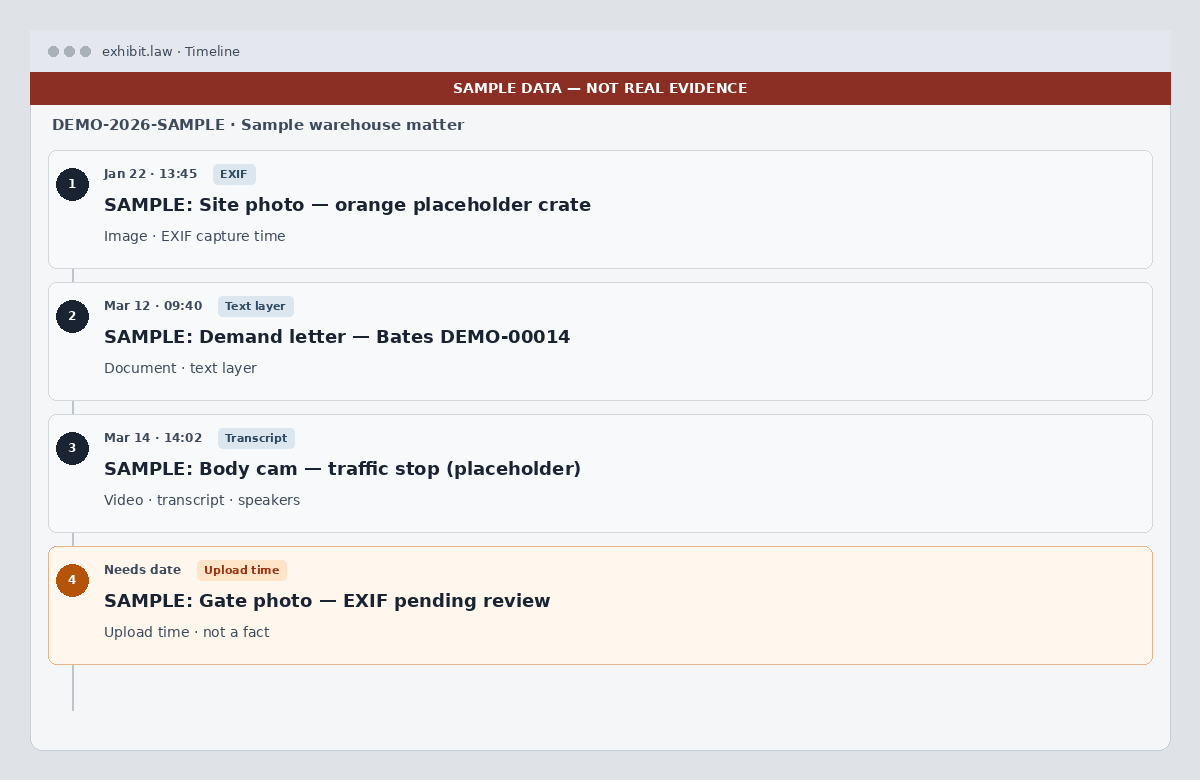
A drafted event often mixes a real EXIF or embedded date with model-written prose. exhibit.law surfaces occurred-at provenance separately from title and description — EXIF, embedded metadata, suggested by AI, or upload time as a warning — so reviewers do not treat a storage timestamp as when the thing happened.
Bulk review refuses to mark upload-time dates as reviewed until a person sets a real moment. Flagging and clearing stay available for triage.
Depositions and long A/V
Long audio and video become timed transcripts with segments you can scrub and search. Speaker labels help map voices to people on the matter. That is the path from a deposition recording to citeable phrases on the chronology — still behind human review for any AI-drafted event cards.
Build one chronology
Create a free account, upload a small mixed set (PDF, photo with EXIF, short A/V), process the batch, and clear Review before trusting the calendar.
Related: discovery management, legal document OCR, body-cam transcription, and contact for firm or public-defender rates.