Body-cam transcription for legal teams
Body-worn camera video is often the densest exhibit in a case — and the hardest to work from as a raw file. exhibit.law is built so that footage lands in a single matter, becomes a timed transcript with speakers identified, and stays searchable for everyone invited to that case.
This page describes what the product does today. It is not a claim that every department or camera system is certified, and it is not legal advice.
Why body-cam is hard as a folder of files
A shared drive or Evidence.com export gives you bytes and filenames. It does not give you a citeable timeline of who said what, when. Reviewers scrub video by ear, miss parallel threads, and cannot search a phrase across dozens of hours without watching again.
For privileged work, that pile of media also needs to stay inside one matter — not mixed into a firm-wide library where the wrong person can open the wrong file.
What exhibit.law does with body-cam
Upload body-cam (and other A/V) into the active case. The server-driven pipeline normalizes audio, runs transcription, and attaches a timed transcript to the media row — not to a free-floating note. Speakers are identified so you can follow who is talking as you review.
AI processing uses self-hosted models or third-party providers, depending on the feature and deployment configuration, under applicable no-training terms. If you need a dedicated or self-hosted deployment, contact us to discuss scope, requirements, and fit. AI output remains assistive and subject to human review; see the AI Disclosure for the current posture.
- Timed transcript segments stay with the media file
- Speaker labels help you map voices to people in the case
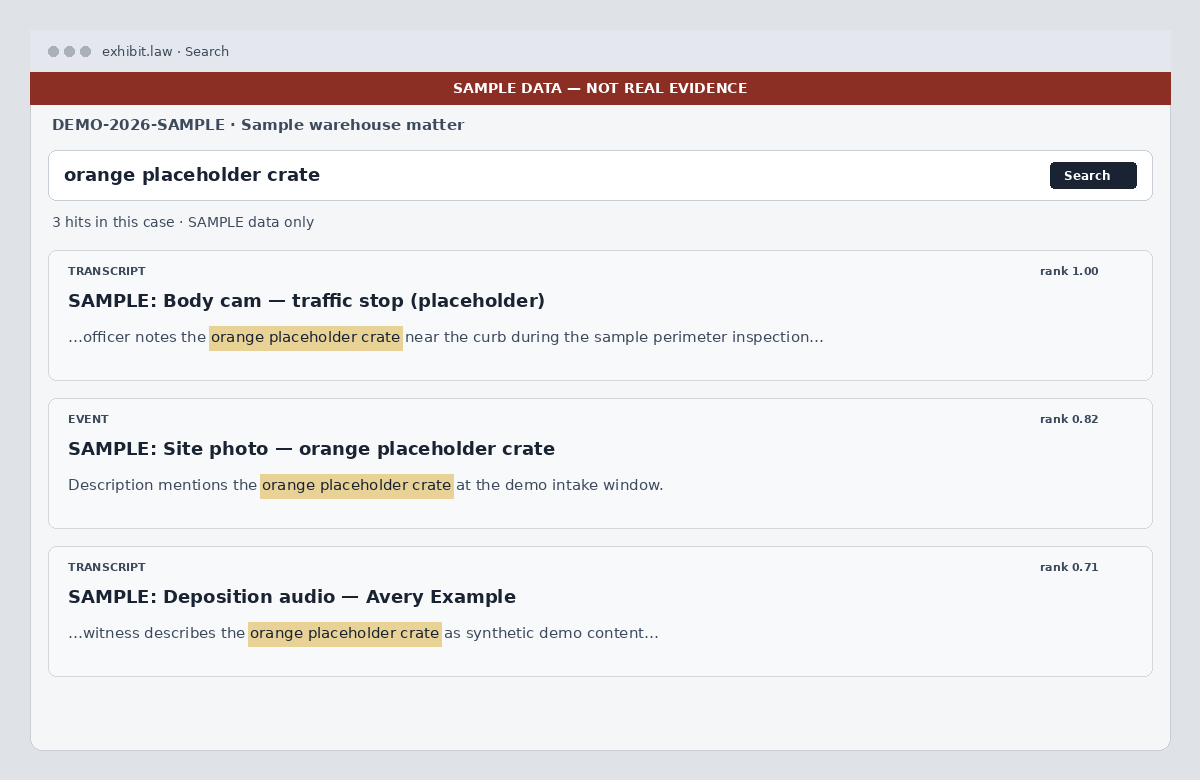
- Search ranks phrases across transcripts and event text in that matter
- Access is grant-based: invitees see only cases they were invited to
Human review before dates harden
AI drafts for timeline events stay not-reviewed until someone confirms them. Provenance chips show whether a date came from embedded metadata, a model suggestion, or upload time — and upload-time dates are treated as placeholders, not facts, until a person sets a real moment.
The tool assists triage. It does not practice law or declare unreviewed drafts as confirmed evidence.
Try it on a matter
Create a free account, open a case you control, and upload a body-cam clip to see the transcript and review flow. For enterprise or public-defender rates, use the contact form.
Related: discovery management workflow and Evidence.com zip imports.